
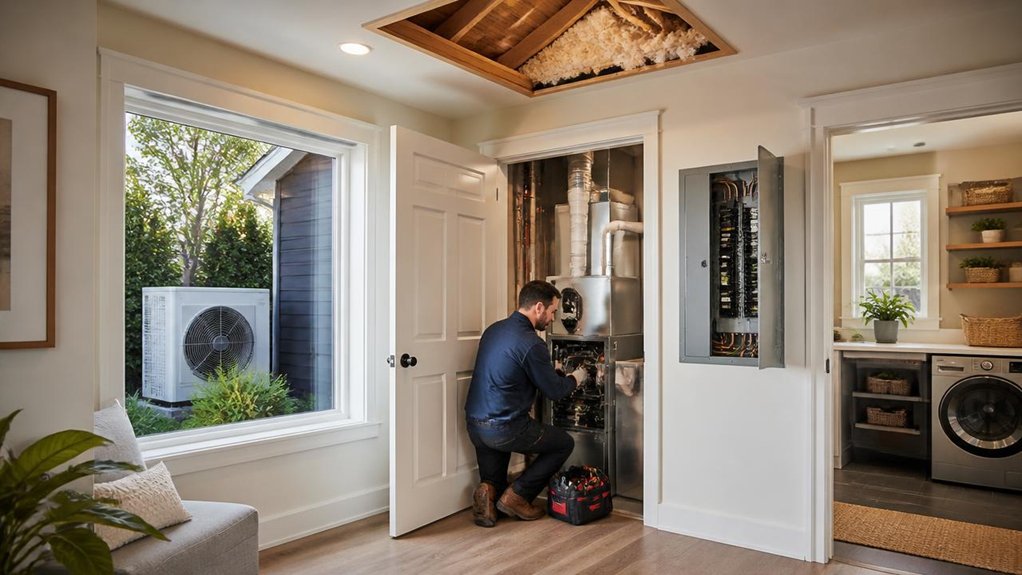
Frequent repairs, uneven room temperatures and rising energy bills can justify checking whether a heat pump suits your home, but they do not prove it is ready. Check insulation, draughts, heat loss, radiator sizes and the electrical supply before accepting an installer’s quote. A heat-loss calculation for each room helps show whether the radiators can deliver enough heat at the lower water temperatures a heat pump uses.
Is Your HVAC System Ready for a Heat Pump Upgrade?
A qualified installer should check your existing heating system before you choose a heat pump. They need to assess the heat pump’s output in kW against your home’s heat loss, as well as the controls, radiators and electrical supply.
The result depends on your home’s insulation, room-by-room heat loss and the temperature your radiators need to reach.
A heat pump may work with existing radiators, but some may need replacing with larger ones if they can’t provide enough heat at a lower flow temperature. A Gas Safe registered engineer must handle work on a gas boiler.
Electrical work must comply with Part P of the Building Regulations in England and Wales and be completed or certified by an electrician registered with a competent person scheme. Use an MCS-certified installer if you need an MCS certificate for a grant or other scheme.
Check the ducts if you’re considering a ducted system. Leaks, poor insulation or ducts that are too small can reduce airflow and comfort; a professional can measure airflow and recommend repairs.
A ductless heat pump may suit a home without ducts, but the installer still needs to check room-by-room heat loss and electrical capacity.
You can check your energy bills, note radiator sizes and look for visible draughts yourself. Leave heat-loss calculations, system design, refrigerant work and changes to the gas supply or fixed wiring to qualified professionals.
Put your own figures into our payback calculator.
Are Frequent Repairs a Sign to Replace Your HVAC?
Frequent repairs: Rising costs may make replacement better value, but compare the repair quote with a replacement quote before deciding.
Best for: Systems with repeated faults
Check first: Repair history and warranty
Compare: Repair quote with replacement quote
Replacement option: Heat pump or new boiler
Decision factor: System age and condition
Rising Repair Costs
Frequent repair bills can make replacement worth considering, but compare like-for-like costs before deciding. List each repair, including parts and labour, and compare the total with a replacement quote for a heat pump or another suitable heating system. Check what the quote includes, such as radiator upgrades, controls and electrical work.
There is no reliable payback figure without your home’s heat demand, current fuel use, energy tariffs and installation cost. For a heat pump, compare estimated annual electricity use in kWh with the fuel and electricity it would replace; the result depends on the system’s seasonal efficiency, insulation, flow temperature and tariffs.
Check current costs and any grant eligibility with GOV.UK, Ofgem or the Energy Saving Trust, as prices and support can change.
A competent DIYer can record bills, check the system’s age and compare quotes. Use a Gas Safe registered engineer for work on gas appliances, and an MCS-certified installer if you need an MCS installation certificate for a heat pump or to meet a scheme’s requirements.
Electrical work must comply with Part P of the Building Regulations; use an electrician registered with a competent person scheme where required. Put your own figures into our payback calculator.
Recurring System Breakdowns
Recurring faults can make a heating system less reliable, but they don’t prove it’s near the end of its life. Note which parts fail, how often repairs are needed and whether the same fault returns; this helps an engineer assess whether repair or replacement makes better financial sense.
Check the warranty terms before paying for repairs, as cover depends on the fault and conditions. A competent DIYer can record symptoms and check the manufacturer’s guidance, but shouldn’t open or repair a boiler, heat pump or electrical controls.
Use a Gas Safe registered engineer for gas work, or an appropriately qualified heat-pump engineer; electrical work may need a registered electrician under Part P of the Building Regulations.
Repair Versus Replacement
Frequent repairs alone don’t prove your heating system needs replacing. Compare the repair cost with a replacement quote, then factor in the boiler or heat pump’s age, efficiency and ability to keep rooms warm.
Replacement may make financial sense if costly repairs recur, the system can’t maintain your chosen temperature, or energy use rises without a change in how you heat your home. Ask an engineer to identify the faulty part and say whether another repair is likely to last; no one can predict an exact repair lifespan.
A qualified Gas Safe engineer must work on gas appliances. For a heat pump, use an MCS-certified installer and check whether your home’s insulation, radiators and existing pipework can deliver enough heat at a lower flow temperature. Check current requirements before work starts, as rules and certification schemes can change.
Will a Heat Pump Lower Your Energy Bills?
A heat pump can cut heating costs if it replaces electric resistance heating or an inefficient heating system. It moves heat rather than generating it, so it can use less electricity, but savings depend on the home, system and energy tariff.
Heat pumps can cut heating costs by using less electricity, but savings depend on your home, system and tariff.
Typical cost: Check current installer quotes
Likely saving: Depends on home and tariff
Payback period: Calculate from your figures
Best suited: Well-insulated homes
Key factors: Heat demand and unit prices
Good
- Replacing electric resistance heating can reduce electricity use.
- Lower heat demand can improve running costs.
- Seasonal efficiency affects the electricity needed for heating.
Not so good
- A high electricity tariff can weaken savings.
- Poor insulation can increase heat demand.
- Cold weather can raise electricity use.
- Replacing a working, efficient system may not pay back.
A heat pump may suit households replacing electric resistance heating, where lower electricity use can reduce bills. It may not be worth replacing an efficient system if the installation cost outweighs likely savings. Compare your current annual heating use and tariff with an installer’s estimate for the proposed system; without those figures, a reliable cost range or payback can’t be given.
Best for: Homes replacing electric resistance heating.
Skip it if: Your current system is efficient and replacement costs exceed likely savings.
Put your own figures into our payback calculator.
Can a Heat Pump Fix Uneven Room Temperatures?
Uneven temperatures don’t automatically mean you need a heat pump.
Check room temperatures, radiator sizes, thermostat settings and draughts first; a heat pump is worth considering only if it suits the home’s heat loss and existing heating system.
Finding Temperature Imbalances
Record temperatures in several rooms at different times of day, noting the room, time and thermostat reading. Repeat when the heating is on and off, and note whether sunlight or outdoor weather changes the pattern.
Check that the thermostat is away from draughts, windows and heat sources; these can affect its reading. Look for gaps around windows, doors, loft hatches and accessible pipework, and check whether rooms have working radiators or clear air vents.
Temperature checks and visual inspections are safe DIY tasks; don’t alter a gas boiler or fixed wiring. A heating engineer can investigate system faults, and any gas work must be done by a Gas Safe registered engineer.
Improving Room-to-Room Comfort
Uneven room temperatures don’t automatically mean you need a heat pump. Check for blocked vents, leaking or poorly insulated ducts, draughts and incorrect radiator balancing first.
A competent DIYer can clear vents, draught-proof accessible gaps and bleed radiators; leave duct repairs and system balancing to a qualified heating professional.
A heat pump may improve temperature control, but it won’t fix poor insulation or badly designed ductwork.
Room-by-room zoning can help when different areas have distinct heating needs, but it adds controls and may not be worth the cost in a small, open-plan home. Ask an installer to identify the cause before accepting a quote.
If work involves fixed electrical wiring, use an electrician registered with a competent person scheme. Gas boiler work must be done by a Gas Safe registered engineer.
For a heat pump installation, check that the installer is MCS-certified if you need MCS certification for a grant or other scheme. Check current rules and scheme requirements before work starts.
Is a Heat Pump Right for Your Climate?
A heat pump suits a UK home when its output matches the property’s heat loss at the local design temperature. Ask the installer to calculate heat loss room by room and size the system in kW; a model that’s too small may struggle in cold weather, while an oversized one can cycle inefficiently.
Match the heat pump’s output to your home’s heat loss at the local design temperature to avoid poor performance or inefficient cycling.
Check the manufacturer’s data for the heat pump’s output and efficiency at low outdoor temperatures, not just its headline rating. Your installer should also check whether radiators can heat rooms with lower flow temperatures, typically around 35–55°C depending on the system and home.
Better insulation and draughtproofing can reduce the required output and running costs.
In milder parts of the UK, standard air-source models may meet the design heat loss. In colder locations, a model rated for low temperatures may be more suitable.
Ask for the proposed system’s performance at your area’s design temperature and an estimate of annual electricity use in kWh; compare it with your current heating costs using your actual tariff.
A heat pump can also cool some homes, but not every system does. Check that the model and emitters support cooling, and ask how it will control indoor humidity.
Cooling may not be worth paying extra for if you rarely need it.
A competent DIYer can improve loft insulation, seal draughts and compare energy bills, provided the work meets applicable building regulations. Heat pump design and installation should be handled by a qualified installer; electrical work must comply with Part P of the Building Regulations and be completed or certified by an electrician registered with a competent person scheme.
If the system connects to gas, a Gas Safe registered engineer must handle that work. For eligible installations, check current MCS requirements and grant rules on GOV.UK; amounts and eligibility can change.
Good
- Low-temperature output data shows performance in cold weather.
- Room-by-room heat-loss calculations help size the unit.
- Better insulation can reduce the required heat-pump capacity.
- Some models provide cooling if the system supports it.
Not so good
- Poor insulation can require a larger, costlier system.
- Existing radiators may need replacing for lower flow temperatures.
- Cold-weather efficiency varies by model and outdoor temperature.
- Cooling isn’t available on every heat-pump system.
What Should You Check Before Installing a Heat Pump?
Check the outdoor unit’s proposed position, available access and the route for pipes and cables before accepting a quote. Ask the installer to confirm that the electrical supply and consumer unit can support the heat pump’s rated electrical input in kW; the system may need a dedicated circuit or an electrical upgrade.
For a ducted system, check for leaks, damage and poor insulation in the existing ductwork. Ask whether your radiators or underfloor heating can heat the rooms at the lower flow temperatures the heat pump will use. The answer depends on the heat loss of each room and the heat emitters’ output at that temperature.
Confirm where defrost water will drain, whether the unit’s position meets noise and planning rules, and whether installers can get equipment to the site.
A competent DIYer can clear access and gather details about radiators and the consumer unit, but shouldn’t alter wiring, refrigerant pipework or gas appliances. Electrical work should be done by an electrician registered with a competent person scheme; work on gas appliances requires a Gas Safe registered engineer.
For MCS certification, use an MCS-certified installer and check current planning requirements with your local council.
Frequently Asked Questions
How Long Does a Heat Pump Installation Usually Take?
A heat pump installation usually takes one to three days. The time depends on the system type, the condition of your existing heating and whether the installer needs to alter pipework or fit new radiators. Electrical upgrades, repairs or delays with permits can extend the work.
What Maintenance Does a Heat Pump Need?
Clean or replace the air filter monthly, following the heat pump manufacturer’s instructions. Check the outdoor unit regularly and remove leaves, snow and other debris; keep the manufacturer’s required clearance around it.
Check that condensate drains away freely, especially in cold weather. Arrange an annual service if the manufacturer recommends one; ask the engineer to inspect the coils, fan, refrigerant circuit and electrical connections. A dirty filter can restrict airflow, but the effect depends on the filter and unit, so don’t assume it cuts performance by a fixed percentage.
How Long Can I Expect a Heat Pump to Last?
A heat pump typically lasts around 10–15 years, but its lifespan depends on maintenance, how hard it works and the quality of installation. The compressor is a major component; a fault can make replacement uneconomic, depending on the repair cost and the system’s age.
Watch for repeated repairs, higher electricity use or rooms that no longer reach the set temperature. Ask an installer to check the system before assuming it needs replacing.
Can a Heat Pump Provide Both Heating and Cooling?
A heat pump can heat your home in winter and cool it in summer by reversing the direction of heat transfer. In heating mode, it moves heat indoors; in cooling mode, it moves heat outdoors. Not every model provides cooling, so check the manufacturer’s data sheet and confirm that the system’s controls and emitters support it.
Cooling performance depends on the heat pump’s output in kW, the home’s insulation and the room equipment. Underfloor heating or fan coil units can provide cooling; standard radiators generally cannot. Cooling may also need condensate drainage and controls to prevent condensation on cold surfaces.
Good
- Reversible models can provide heating and cooling through the same heat pump.
- Fan coil units can distribute cooled air around a room.
- Cooling may use less electricity than a separate air-conditioning system, depending on the equipment and use.
Not so good
- Some heat pumps do not have a cooling mode.
- Standard radiators are generally unsuitable for cooling.
- Cold pipes or floors can cause condensation if controls are not set correctly.
- Cooling adds electricity use and may increase bills.
DIY and installation
A competent DIYer can compare manufacturer data sheets, check room insulation and ask installers to confirm cooling capacity in kW. Do not modify refrigerant pipework or connect electrical supplies yourself. Refrigerant work must be done by a technician with the relevant F-gas certification; electrical work must comply with Part P of the Building Regulations in England and Wales, with notification or certification as required. Use an MCS-certified installer if you need an installation to meet an MCS or grant requirement. A Gas Safe engineer is needed only for work on gas appliances or pipework, not for the heat pump itself.
Verdict
A reversible heat pump suits households that want cooling as well as heating and already have compatible emitters, because one system can serve both needs. Do not add cooling solely to save money: extra equipment and electricity can outweigh the cost of a separate cooling option, depending on use and installation.
Best for: Homes with fan coils or suitable underfloor heating.
Skip it if: Your model lacks cooling or your radiators cannot provide it.
Are Heat Pumps Eligible for Rebates or Tax Credits?
Typical eligibility: Depends on location and scheme
UK support: Check current national grants
Local support: Ask your council and energy supplier
Main condition: Property and installer rules apply
Check before work: Some grants require approval first