
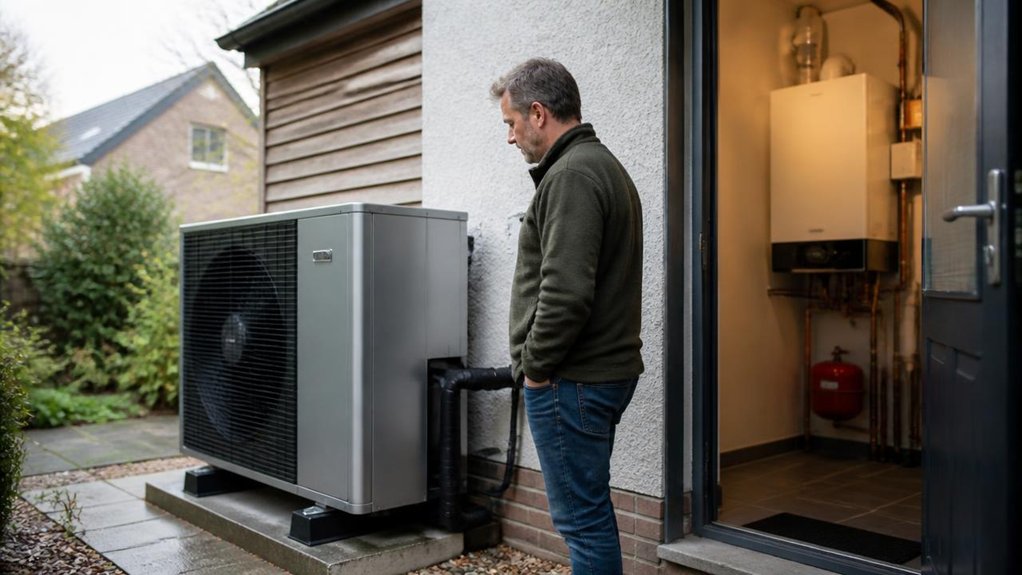
A heat pump can replace a gas boiler if the system can meet your home’s heat demand at a suitable flow temperature. A room-by-room heat-loss calculation, measured in kW, shows the heating capacity needed and helps identify whether insulation or larger radiators are required.
A competent DIYer can draughtproof rooms and fit basic insulation, but should not alter the heating system or electrical supply. Use an MCS-certified installer to design and commission the heat pump; electrical work must meet Part P of the Building Regulations and be done by an electrician registered with a competent person scheme. A Gas Safe engineer must handle work on the gas boiler and pipework.
Typical costs, savings and payback vary with heat demand, electricity and gas tariffs, radiator changes and hot-water requirements. Check current prices and any grant eligibility before comparing quotes. Put your own figures into our payback calculator.
Can a Heat Pump Replace Your Gas Boiler?
A heat pump can replace a gas boiler, but it works best when the home loses little heat and the heating system can deliver enough warmth at lower water temperatures.
Ask an MCS-certified installer to calculate your home’s heat loss in kW and check whether your radiators can meet that demand; larger radiators or insulation upgrades may be needed.
A competent DIYer can improve draughtproofing and fit some insulation, subject to the product and building requirements. A qualified installer should design and commission the heat pump.
A Gas Safe registered engineer must disconnect or remove the gas boiler, and a qualified electrician registered with a competent person scheme should handle electrical work. Check that the installer and work meet relevant Building Regulations and MCS requirements.
Good
- A heat-loss calculation shows whether the proposed heat pump can meet demand.
- Larger radiators can help deliver enough heat at lower water temperatures.
- Better insulation can reduce the heat pump’s required output in kW.
- A heat pump removes the need to burn gas in the home.
Not so good
- Undersized radiators may leave rooms cold when water temperatures are lowered.
- Poor insulation can mean higher heat demand and a larger heat pump.
- Boiler removal requires a Gas Safe registered engineer.
- Backup heating may add cost during cold weather or equipment downtime.
Verdict
This suits homeowners whose heat-loss assessment shows a heat pump can meet demand without costly radiator or insulation work, since that keeps upfront costs and payback more manageable.
Those facing major upgrades shouldn’t bother until they compare the combined costs with keeping or replacing the boiler.
Running-cost savings depend on heat demand, electricity and gas tariffs, and system efficiency, so use your own figures rather than a generic estimate.
Best for: Well-insulated homes with suitable radiators
Skip it if: Major upgrades make the costs unaffordable
Put your own figures into our payback calculator.
How Do Heat Pumps Compare With Gas Boilers?
Heat pumps and gas boilers use different amounts of energy to deliver the same heat. A heat pump’s efficiency depends on its design flow temperature, the outdoor temperature and how well the home retains heat; a boiler’s depends on its seasonal efficiency and controls.
Compare running costs using your home’s annual heat demand, each system’s seasonal efficiency and the unit prices on your tariff. A heat pump can cost more to run if electricity is expensive relative to gas or the system is poorly designed.
Carbon savings also depend on the electricity supply and the boiler’s gas use.
Energy Efficiency
Heat pumps usually deliver 2–4 kWh of heat per kWh of electricity, while gas boilers convert around 90% of their fuel into heat. These figures compare heat output with energy input; they don’t show which system will cost less to run.
Running costs depend on the heat pump’s seasonal efficiency, your electricity and gas tariffs, and how much heat your home needs.
For a fair comparison, use your home’s annual heat demand and current tariffs. Multiply the heat pump’s electricity use in kWh by your electricity price per kWh; multiply the boiler’s gas use by your gas price per kWh.
Check the heat pump’s seasonal performance figure and the boiler’s efficiency in their product data. Colder weather, radiator size, flow temperature and insulation can affect heat pump performance.
Sealing draughts and adding suitable insulation can reduce heat demand, but savings depend on your home and the work involved. A smart thermostat can help avoid heating empty rooms, though scheduling alone won’t fix an inefficient heating system.
Passive house design is most relevant to new builds or major renovations, not usually a simple retrofit.
A competent DIYer can seal minor draughts and adjust thermostat schedules. Use a qualified installer for heat pump design and installation: check for MCS certification if you need it for a grant or scheme.
Gas boiler work must be done by a Gas Safe registered engineer. Electrical work must comply with Part P of the Building Regulations in England and Wales; use an electrician registered with a competent person scheme where required.
Running Costs
Heat pump running costs depend on the heat pump’s seasonal efficiency, your home’s heat demand and the price you pay for electricity. A heat pump uses electricity to move heat, so compare its seasonal coefficient of performance (SCOP) with your electricity tariff and a gas boiler’s efficiency with your gas tariff.
Worked comparison: assume a heat pump supplies 10,000 kWh of heat a year at a SCOP of 3, and a gas boiler is 90% efficient. The heat pump uses about 3,333 kWh of electricity; the boiler uses about 11,111 kWh of gas.
Heat pump cost: 3,333 kWh × your electricity unit rate. Boiler cost: 11,111 kWh × your gas unit rate. Add standing charges only if they’d change between systems, and include servicing and likely repairs.
These figures compare heating energy only, not hot water or installation costs.
Time-of-use tariffs can reduce costs if you can shift heating to cheaper periods without making rooms uncomfortable. A gas boiler may cost less to run when gas is cheap relative to electricity, or when the heat pump has to run at a lower SCOP because of high flow temperatures or poor system settings.
Use your bills and current tariffs for a like-for-like estimate; tariffs and any grant amounts change, so check them at the time of writing.
A competent DIYer can compare bills, check tariff terms and record meter readings. Don’t alter a heat pump’s electrical supply or refrigerant circuit; electrical work must meet Part P of the Building Regulations and be carried out or certified by an electrician registered with a competent person scheme.
Gas boiler work must be done by a Gas Safe registered engineer. For a heat pump installation seeking MCS certification, use an MCS-certified installer.
Environmental Impact
A gas boiler releases carbon dioxide when it burns gas; a heat pump’s emissions depend on the electricity it uses. A cleaner electricity supply generally means lower operating emissions, but the result also depends on the heat pump’s efficiency and how much heat your home needs.
Manufacturing and installation add upfront emissions. Carbon payback is the time needed for operating savings to offset those emissions; it varies with the equipment, home and electricity supply.
Ask the installer how they’ll prevent refrigerant leaks during installation and servicing, and arrange proper recovery at disposal. Choose a qualified installer and keep up with maintenance to reduce the risk of leaks.
Will Your Home Work Well With a Heat Pump?
A heat pump can suit a home with good insulation, suitable radiators and enough space for the equipment. Check the heat loss room by room: an installer uses this in kW to size the heat pump and assess whether each radiator can deliver enough heat at a lower flow temperature.
Draughts and poor insulation increase heat loss, so the heat pump may need larger radiators or more insulation to keep rooms warm. The layout matters too: long pipe runs, separate rooms and closed doors can make heat distribution harder to balance.
Your local winter temperatures affect performance, but they don’t determine suitability on their own. Ask for a room-by-room heat-loss calculation and radiator assessment before accepting a quote.
A competent DIYer can draught-proof gaps and add loft insulation where appropriate; a qualified installer should design and fit the heat pump. For electrical work, use an electrician registered with a competent person scheme; for work on a gas boiler, use a Gas Safe engineer.
Check that the heat-pump installer is MCS-certified and that the design meets relevant building regulations.
What Might Need to Change in Your Heating System?
Check whether your radiators can heat each room with lower-temperature water. A heating installer can calculate the room-by-room heat loss in kW and compare it with each radiator’s output at the proposed flow temperature; radiator size alone doesn’t show whether it will work.
If a radiator’s output is too low, you may need a larger radiator or an additional one. Existing pipes may also need upgrading if they can’t carry enough water, but this depends on the system design and should be checked before you accept a quote.
A heat pump usually heats a hot water cylinder, so you may need space for one if you currently have a combi boiler. A competent DIYer can measure available space, but a qualified installer should assess and connect the heating system.
Electrical work must comply with Part P of the Building Regulations and be done by an electrician registered with a competent person scheme; any work on gas pipework must be done by a Gas Safe registered engineer.
Radiator and Pipe Compatibility
Most existing radiators and pipes can work with a heat pump, but the answer depends on radiator size, pipe capacity and the heat loss from your home.
Heat pumps usually supply cooler water than gas boilers, so radiators may need to run for longer, particularly in cold weather.
Ask an installer to check whether each radiator can meet the room’s heat demand at the proposed flow temperature. A larger radiator may be needed if it cannot; adding one without checking the room’s heat loss may not help.
Insulating accessible heating pipes can reduce heat loss, but it’s less useful where pipes run through already-warm rooms.
A competent DIYer can insulate accessible pipes. A qualified heat-pump installer should assess radiator sizing, pipework and system changes.
Electrical work must comply with Part P of the Building Regulations and be completed or certified by an electrician registered with a competent person scheme. If the work affects a gas boiler, use a Gas Safe registered engineer.
For an MCS-certified installation, check that the installer and proposed system meet the relevant MCS requirements.
Hot Water Cylinder Installation
Typical cost: £1,000 to £2,500
Best for: Homes switching to a heat pump
Space needed: Often an airing cupboard or utility room
Check first: Doorways, stairs and floor strength
Extra work: Valves, controls and pipework
Good
- A cylinder stores hot water for use when the heat pump isn’t running.
- An airing cupboard, utility room or loft may provide suitable space.
- Check door and stair widths against the cylinder’s dimensions before delivery.
- Allow access to valves, controls and the cylinder for maintenance.
Not so good
- A cylinder may not fit through narrow doorways or stairs.
- A loft needs a suitable floor and a safe route for installation.
- Longer pipe runs can increase heat loss unless pipes are insulated.
- New valves, controls and pipework can add to installation costs.
A hot water cylinder suits homes switching from a gas boiler to a heat pump, where stored hot water is needed and there’s room for the cylinder.
The cost depends on cylinder size, access and how much pipework or control work is needed; check an itemised installer’s quote before comparing options.
A competent DIYer can measure the space and clear the route, but shouldn’t connect or commission the system.
A qualified installer should size and fit the cylinder; electrical work must meet Part P of the Building Regulations, and any gas work must be done by a Gas Safe registered engineer.
Best for: Homes with space and a heat pump
Skip it if: There’s no suitable space or access
What Does a Heat Pump Installation Cost?
A heat pump installation typically costs £6,000 to £15,000, but the price depends on the system, home and required changes to electrics, radiators or pipework.
This range isn’t a fixed quote; check current prices and get written estimates for your property.
Ask each installer to itemise the heat pump, hot water cylinder, labour, removal of the old boiler, electrical work, controls and any changes to radiators or pipework.
Compare like-for-like quotes, including commissioning, materials and any required permits. Check current grant eligibility on GOV.UK before signing, and confirm the installer’s MCS certification if you plan to claim an eligible grant.
A competent DIYer can clear access, take measurements and compare quotes. Leave refrigerant-system work and commissioning to a suitably qualified heat pump installer.
Electrical work must meet Part P of the Building Regulations and be completed or certified by an electrician registered with a competent person scheme. If the job involves gas work, use a Gas Safe registered engineer.
Ask for the proposed system’s capacity in kW, estimated annual electricity use in kWh, warranty terms and payment schedule.
The running-cost comparison depends on your home’s heat demand, the heat pump’s seasonal efficiency and your electricity and gas unit rates, so a reliable yearly saving and payback need those figures.
Put your own figures into our payback calculator.
Is a Heat Pump Right for Your Home?
A heat pump suits a home that can stay warm with water at a lower temperature than a typical boiler uses. Start by checking insulation, radiators or underfloor heating, outdoor space and hot-water demand; an MCS-certified installer can assess whether the system will meet your needs.
Heat pumps work best in well-insulated homes with heating systems that deliver warmth at lower water temperatures.
If your home loses heat quickly, draughtproofing and insulation may reduce the heat pump size required.
Check radiator sizes and the system’s flow temperature: undersized radiators may need replacing or upgrading to deliver enough heat.
Compare the installer’s quote and estimated annual running costs with your boiler costs, using your actual energy tariffs and heat use.
Ask for the assumptions behind the estimate, including the heat pump’s seasonal efficiency and the electricity tariff. Incentives may change affordability, but check current eligibility and amounts on GOV.UK.
Put your own figures into our payback calculator.
Frequently Asked Questions
How Long Does a Heat Pump Typically Last?
A heat pump typically lasts 15 to 20 years, but the compressor and other components may need repair or replacement sooner. Regular servicing, correct system sizing and installation, and avoiding excessive cycling can help extend its working life. Cold or damp conditions alone do not determine lifespan; maintenance and how often the system runs also matter.
How Often Does a Heat Pump Need Servicing?
Arrange a heat pump service once a year, or follow the interval in the manufacturer’s instructions. A qualified heat pump engineer should check the refrigerant circuit, electrical connections, controls and system performance; they can also clean the heat exchanger if needed.
You can clean or replace accessible filters and keep outdoor units clear of leaves and debris. Do not open the refrigerant circuit or remove electrical covers: refrigerant work must comply with the F-gas regulations, and electrical work must meet Part P of the Building Regulations where applicable. Use an appropriately qualified engineer for those jobs.
Can a Heat Pump Provide Cooling in Summer?
A heat pump can cool your home in summer if it is a reversible model. Its reversing valve changes the refrigerant flow so the indoor unit removes heat from the room and releases it outside.
Cooling performance and energy use depend on the heat pump model, controls and home. Check the manufacturer’s data sheet for its cooling capacity in kW and electricity use; not every heat pump provides cooling.
Are Heat Pumps Noisy When Operating?
Outdoor heat pump units make a low operating noise; indoor units are usually quieter. The sound varies with fan speed, defrost cycles, maintenance and where the unit sits. Check the manufacturer’s sound data for the model, and ask the installer to assess noise at nearby windows and neighbouring homes.
What Grants or Incentives Are Available for Heat Pumps?
Heat pump support in the UK depends on where you live and which system you install. Check GOV.UK and your local council for current grants, and ask your energy supplier about heat pump tariffs or rebates; eligibility and amounts can change.
In England and Wales, the Boiler Upgrade Scheme may contribute towards an eligible heat pump installation. Scotland and Northern Ireland have separate support schemes, so check their current rules. Confirm that your installer and proposed system meet the scheme requirements before signing a contract.
A grant reduces the upfront cost, but it does not guarantee a good payback. Compare the net quote with your expected annual electricity use and heating costs, using your home’s heat demand, the heat pump’s seasonal performance and your electricity tariff. Put your own figures into our payback calculator.